
Our lead asset, BRM421, is on track to become the first treatment for Dry Eye Disease (DED) that acts through a novel mechanism of corneal repair.
BRIM Biotechnology is leveraging its PDSP platform to accelerate innovation and bring novel ophthalmic treatments to market.
About Dry Eye Disease
Dry eye disease (DED) is a common condition in industrialized and aging societies, characterized by a complex, multifactorial etiology. Its prevalence of this ocular disease varies with geographic environment, season, and lifestyle factors. Global prevalence ranges from 5% to 50%. Women generally have 1.3- to 1.5-fold higher prevalence than men, and rates are higher among Asian populations. The prevalence also increases significantly with age.
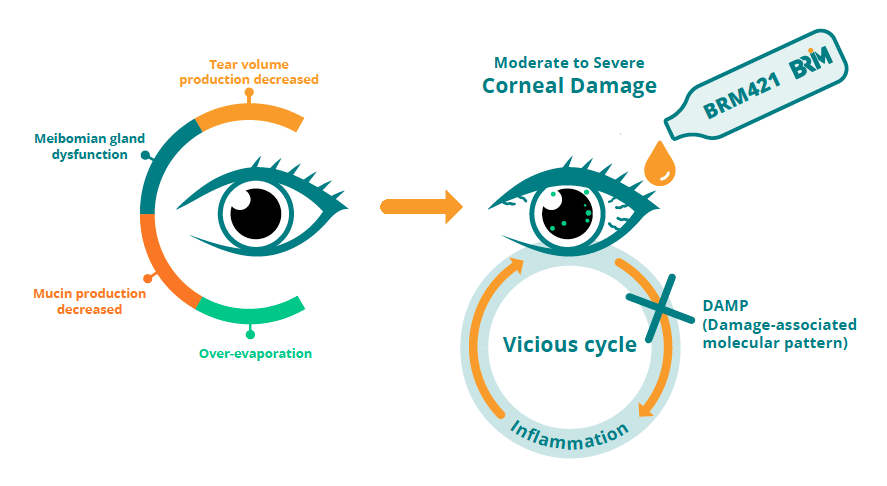
Patients with DED can be broadly classified into two types: those with insufficient tear production and those with excessive tear evaporation caused by changes in tear film composition. In both cases, the instability of the tear film prevents proper maintenance of ocular surface moisture, leading to ocular dryness. This ultimately causes damage and shedding of conjunctival and corneal epithelial cells, resulting in symptoms such as eye redness, dryness, itching, sensitivity to wind or light, blurred vision, stinging, foreign-body sensation, sticky discharge, and reflex tearing. In severe cases, filamentous adhesions may develop due to corneal epithelial breakdown, leading to corneal–conjunctival lesions, visual impairment, and other serious complications that affect vision, work performance, and quality of life.
The tear film is mainly composed of lipids secreted by the meibomian glands, mucin secreted by goblet cells, and an aqueous layer. Insufficient tear secretion, meibomian gland dysfunction, reduced mucin production, and increased tear evaporation can all damage the ocular surface epithelium. This damage triggers an inflammatory response mediated by damage-associated molecular patterns (DAMPs), creating a vicious cycle that further injures the epithelial cells.
Proposed MoAs of PDSP for DED treatment
BRM421 is an innovative neurotrophic peptide with a novel mechanism of action. It activates limbal stem cells to accelerate corneal repair, improves tear quality and visual function, and breaks the vicious cycle of inflammation. The therapy demonstrates early-onset efficacy and a favorable safety profile.
In addition to clinical evidence showing corneal repair within 1–2 weeks, BRM421 is distinguished as the only therapy that addresses dry eye disease through multiple mechanisms of action. Upon successful completion of Phase 3 clinical trials, it is expected to provide patients with a comprehensive treatment option for dry eye disease.
Accelerate corneal repair
Activate limbal stem cells
Improve tear quality
Maintain goblet cell number
Restore meibomian glands
Improve visual functions
Promote neurotrophic tissue protection
Break vicious cycle
Inhibit inflammation
The key niche value of BRM421

BRM421 treats DED by multiple MOAs to ensure efficacy and give patients better treatment options

BRM421 improves signs and symptoms in 2wks showing early onset compared to anti-inflammation drugs

With over 80% profit margin, BRM421 can be priced affordably at half of the current drug price

BRM421 has no drug-related SAE. No patient dropout due to treatment in 3 clinical trials, with over 1000 patients